

Revve has no banking-specific compliance certifications and no built-in advisor-routing or branch logic. Anything in this recipe that sounds bank-specific — “speak with an advisor,” “mortgage,” “branch” — is scenario dressing you write into the prompt, not a product feature. The calendar-checking and booking tools themselves are generic: they read and write to whatever calendar app your team connects.
Prerequisites
- A published Voice Agent.
- A calendar app connected under Apps in the dashboard, on a plan that supports the “book meeting” feature. Pick one:
- Calendly — click Connect Calendly and complete the OAuth authorization on Calendly’s site. No manual fields.
- Cal.com — fill in Alias (a friendly name, e.g. “[Advisor Team Calendar]” — useful if you’ll connect more than one), API Key (click Validate before saving), Event Length (minutes), and Event Type ID.
- Chili Piper — fill in Tenant ID and Subdomain, then choose a mode with the Use Routing toggle: routing mode needs a Router Slug and API Key (plus an optional Router Form Mapping if you want to override the default email/first name/last name mapping); direct-link mode needs an Owner Booking Link Field and a Direct Link Form Mapping.
Step 1: Confirm your calendar app is connected
Go to Apps in the dashboard and check that your Calendly, Cal.com, or Chili Piper connection shows as active. If it isn’t there yet, connect it now using the fields above — the two tools you add in the next steps can’t do anything without a calendar app behind them.Step 2: Add the “Check Calendar Availability” tool
Open your Voice Agent, go to Advanced Settings → Tools. This tab starts empty: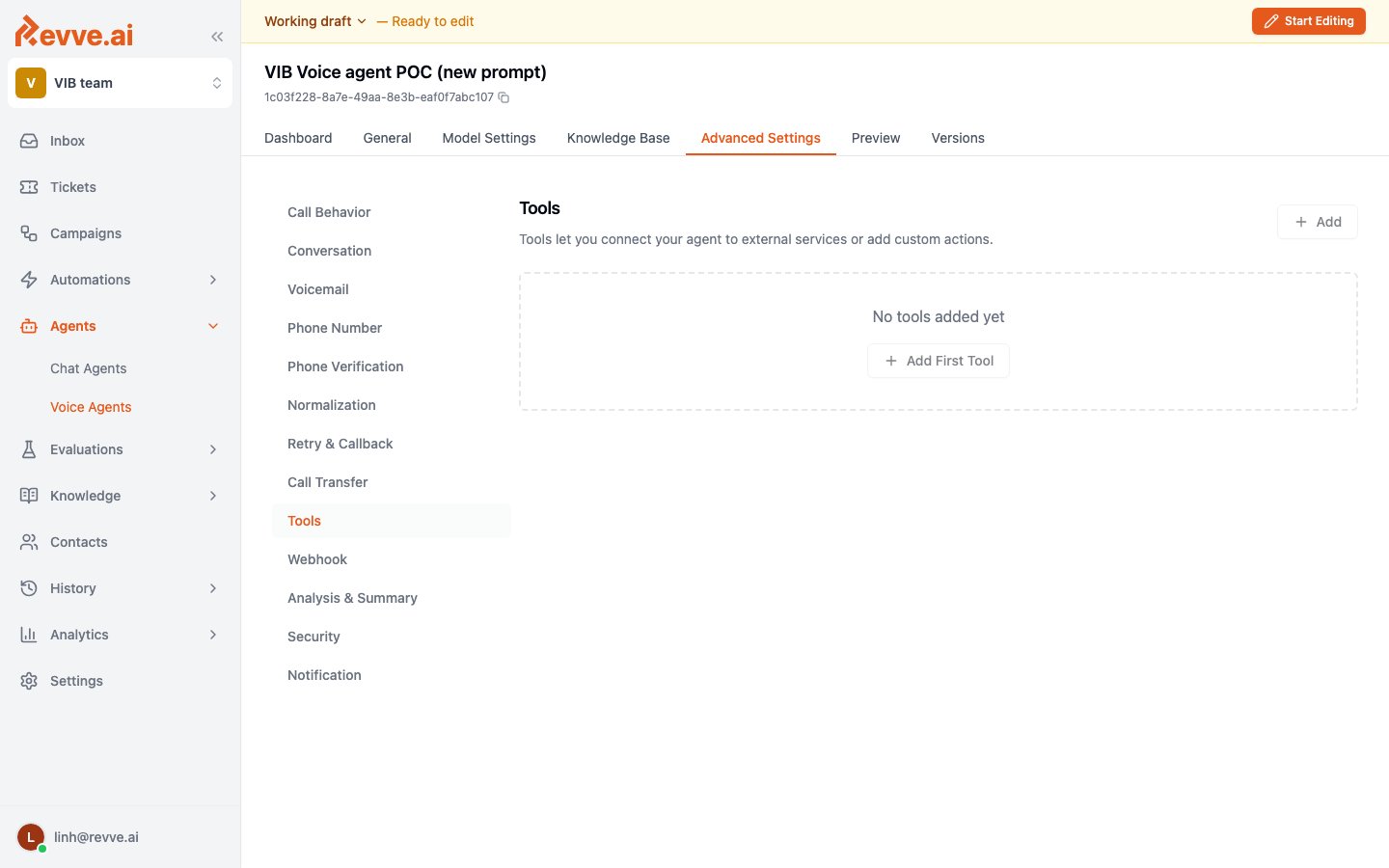
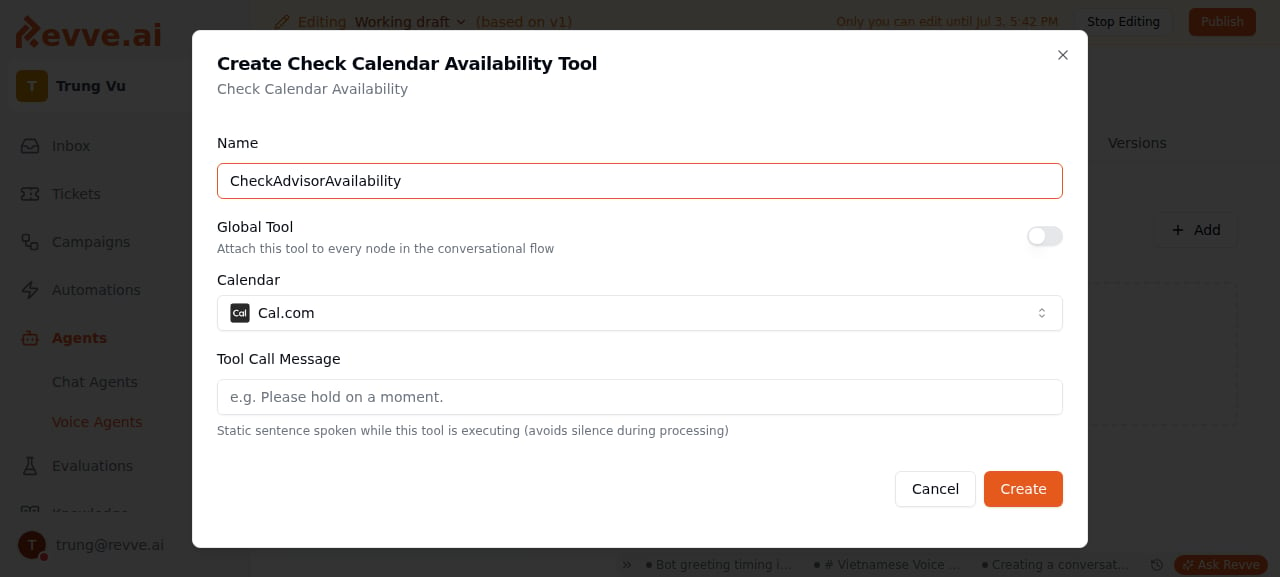
Step 3: Add the “Book on the Calendar” tool
Still on the Tools tab, click + Add again and choose Book on the Calendar. Configure it the same way:
Point both tools at the same calendar — the agent needs to book into the same place it just checked, or it can end up offering a slot from one calendar and writing the appointment into another. If you chose Chili Piper, set the same Chili Piper Booking Method here as you did in Step 2.
Step 4: Tell the agent when and how to use the tools
Adding the tools makes them available; the agent still needs instructions for when to reach for them and what to say around them. Add this to your System Prompt (Single Prompt engine) or to the Instruction of the node where booking should happen (Conversational Flow engine):CheckAdvisorAvailability, BookAdvisorAppointment) must match exactly what you typed into the Name field in Steps 2 and 3.
Test scenarios
Run these from Preview before publishing:
Fix issues at the field level: wrong or invented times → sharpen the instruction’s rule about only offering times the tool returned; booking the wrong calendar → recheck that both tools point at the same Calendar value; tool never fires → check the Name fields match what the prompt calls, with no spaces.
Variations
- Outbound callback booking: the same two tools work on outbound calls — e.g. a callback campaign where the agent says “I have some times open this week, would any of these work?” instead of waiting for the caller to ask. The prompt instructions from Step 4 apply unchanged.
- Inside a Campaign: pair this Voice Agent inside a Campaign the same way Build a Payment Reminder Campaign pairs a voice and SMS agent. Note the difference in mechanism: that guide’s “Branch appointment reminder” variation reminds and reschedules an appointment that already exists (a call now, an SMS fallback later); this recipe books a brand-new appointment live, during the call itself. Use this recipe for the booking step, and the campaign guide’s pattern if you also want reminder/reschedule follow-up around it.
- Router vs. Direct Link (Chili Piper): Router costs one more step (submitting data before assignment) but lets you route callers dynamically; Direct Link is faster to set up and simpler to reason about, but ties every booking to one fixed link. Start with Direct Link for a single advisor or team; move to Router once you need the agent to route by criteria it learns during the call.
What’s Next
- Voice Agent Settings — every setting on the tabs this recipe touches, including the rest of what the Tools row can do.
- What Is a Voice Agent? — the concepts behind Voice Agents if you’re new to them.
- Build a Lead Qualification Agent That Books Meetings — the chat-side equivalent, using the same calendar apps through the Schedule Meeting flow node.