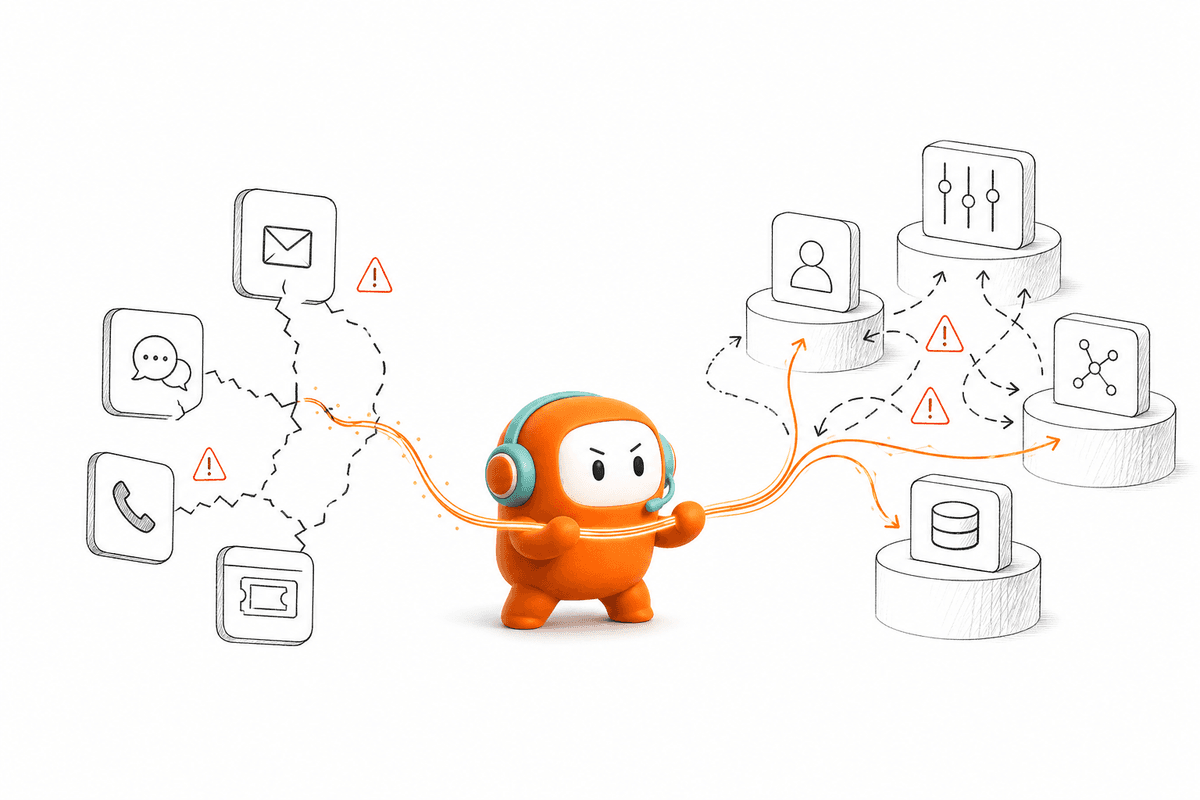
Your collections team approved a new contact window on Monday, but the dialer used Friday's rule and placed the call after the window closed. The account moved into manual review, follow-up stopped, and payment recovery process delays began before an agent ever spoke to the customer. Compliance fails when approved policy doesn't control the next contact in real time. If consent status or an opt-out sits in a separate system, automation can make the wrong action faster and leave your team to repair it.
A faster call doesn't create a faster recovery workflow if consent still needs manual verification. The same is true when an agent must check local contact windows, search for previous disclosures, or confirm whether another channel already received an opt-out. Speed comes from putting policy checks inside the work, not after it.
Key Takeaways:
- Trace recovery delays back to the first missing policy decision, not the final contact attempt.
- Make consent, contact restrictions, and opt-outs available to every outreach channel.
- Separate clear policy blocks from cases that genuinely require human judgment.
- Record why each contact was allowed, blocked, paused, or escalated.
- Test policy updates against realistic customer scenarios before publishing them.
- Keep legal ownership with your organization, even when software applies configured rules.
Why Payment Recovery Process Delays Begin Before Contact

The Collector Isn't Always the Bottleneck
At 8:40 on a Monday, a collections supervisor opens the morning queue and sees 60 accounts flagged ready for outreach. The dialer holds the phone numbers, but consent status sits in the CRM, local contact windows live in a policy PDF, and SMS opt-outs are stored in a separate messaging tool. Before the first attempt, someone has to compare four sources and decide which record is current. By the time that reconciliation finishes, half the permitted call window has already closed.
The visible delay appears in the collector queue, so managers often blame staffing or call capacity. The actual delay happened earlier, when no single system could make a complete contact decision. Adding another agent only gives you another person waiting for the same answer. Payment recovery process delays grow from unresolved policy state, not a shortage of dialing capacity.
Manual review still has value. A sensitive dispute, a hardship request, or an unclear identity match may need a person who can read context and exercise judgment. The mistake is sending every routine eligibility check through that same review path, because the true exceptions get buried beside work that could have been decided from approved rules in seconds.
Fragmented Compliance Creates Repeat Work
Fragmented controls force each channel to rebuild the same decision. Voice checks whether a call is permitted, SMS checks again before sending a reminder, and email may run under a separate workflow with different data. One customer can look eligible in one system and restricted in another, and no agent should have to guess which answer wins.
Payment recovery is closer to air traffic control than a single outbound campaign. Each channel may be cleared to move, but all of them need the same live view of restrictions and prior activity. If one system misses an opt-out or another sends a follow-up after a human escalation, the whole sequence becomes harder to govern.
Recovery delays then compound. A blocked attempt gets reviewed, approved, returned to the queue, and checked again because the approval was never written back to every channel. Customers receive late or duplicated contact while managers spend the day reconstructing why an action happened. The operation feels busy, yet little of that work moves an account toward resolution. The question isn't how to make agents work faster. It is how to make every outreach decision arrive with the policy state already attached.
How to Remove Payment Recovery Process Delays From Workflows
Removing payment recovery process delays requires one decision path from eligibility through contact, response, escalation, and follow-up. Each step should read the same customer status and apply the same approved rules. Once that structure exists, routine checks can run automatically while uncertain cases move to human review.
Find the First Missing Decision
Can your team explain why a payment reminder was delayed without opening three systems? If not, start there. A useful diagnosis follows the account from enrollment to its first completed contact, noting every point where someone waits for data, approval, or another system. The first unexplained pause matters more than the final missed attempt.
Most teams inspect queue age too late in the process. Queue age tells you that recovery timing is broken, but it doesn't show whether the cause was missing consent, an expired contact window, a channel conflict, or an unowned exception. Review ten delayed accounts and record the first decision that couldn't be made from available data. If the same cause shows up in more than three of those ten, that is your shared-rule gap, not a staffing gap.
Ask these questions during the review:
- Can every channel read the current consent and opt-out status?
- Can the system explain why a contact was permitted or blocked?
- Does a customer reply change later steps in the sequence?
- Is every exception assigned to a named queue or role?
- Can an approved change reach all active workflows without manual copying?
If more than one system owner must answer a routine eligibility question, treat that handoff as a recovery delay in its own right. Fixing the final queue won't remove it.
Turn Policy Language Into Executable Checks
Policy documents can't control outreach until their requirements become specific system decisions. A paragraph about permitted contact times needs fields for location, channel, local time, and the action to take when information is missing. Vague policy creates vague automation, and the system either guesses or sends the account to a person.
Operations, compliance, and legal teams should define the rule together, even though that takes more work at the start. A written statement such as "contact only during permitted hours" isn't enough for production use because it leaves the system without a clear input or outcome. Each rule needs a trigger, required data, an allowed action, and a failure path. Missing data should lead to a known hold or escalation, never an improvised contact decision.
Convert each requirement in this order:
- Name the event: Identify the call, message, enrollment, or follow-up that triggers the check.
- List the required inputs: Define which consent, location, account, and channel fields must be present.
- Set the allowed outcomes: Permit, block, pause, reroute, or request review.
- Assign missing-data behavior: Decide what happens when a required field is absent or stale.
- Record the reason: Store the rule and data that produced the decision.
A low-volume team may reasonably keep some checks manual. Once the same check appears in every daily batch, manual review stops being caution and becomes recurring process debt.
Share Customer Policy State Across Channels
A customer can be eligible for one contact method and restricted on another. Shared policy state doesn't mean flattening those differences. It means every workflow can see the same customer history, channel permissions, prior disclosures, and active restrictions before acting.
Consider a customer who answers a call and asks for future contact by SMS. The next step shouldn't depend on an agent remembering to update a separate messaging tool. The request needs to become an event that changes the remaining sequence, while any applicable consent checks still run before the message is sent. Without that shared update, the campaign continues from an outdated version of the customer.
Build the state change around four actions:
- Capture the customer response in the current conversation.
- Update the contact preference or restriction used by other channels.
- Re-evaluate all scheduled steps that depend on that field.
- Log which steps were changed, cancelled, or held.
Shared state also prevents one of the worst payment recovery process delays: a human resolves the case, but an automated reminder remains scheduled elsewhere. At that point, the problem isn't message quality. It is that the systems disagree about whether recovery work is finished.
Separate Clear Blocks From Judgment Calls
A collector sees an account paused for "compliance review," but the label says nothing about the actual problem. One case is outside an approved contact window. Another contains a hardship request that needs judgment. Sending both to the same queue wastes reviewer time and hides the case that needs care.
Deterministic rules should produce deterministic outcomes. If a configured do-not-call restriction applies, block the call and record the reason. If a permitted contact window hasn't opened, hold the attempt until the next allowed period. When customer identity, intent, or circumstances are unclear, route the case to a person with the conversation and account context attached.
The dividing rule is simple:
- If approved data and policy produce one allowed outcome, let the workflow apply it.
- If required data is missing, pause the action and request the missing input.
- If policy allows more than one reasonable outcome, assign human review.
- If the customer asks for a person or raises a sensitive exception, escalate with full context.
Automation has a real limitation here. It can't take ownership of legal interpretation or define your organization's outreach policy. Its job is to apply rules that your legal, compliance, and operations teams have approved, then expose the cases where those rules don't produce a safe answer.
Log the Reason Behind Every Action
Five fields turn an outreach record into usable evidence: event, customer state, rule evaluated, decision, and timestamp. A generic "blocked" status isn't enough. Supervisors need to know what prevented the contact, which data supported that decision, and whether the next step remains scheduled.
Decision logs also cut internal delays. Without them, operations asks compliance why an attempt stopped, compliance asks IT which rule ran, and IT searches system records to reconstruct the event. With the reason stored beside the action, the team inspects the decision directly. A surprising number of process debates are really evidence gaps wearing a process costume.
At minimum, record:
- Event: The call, message, enrollment, update, or escalation being evaluated.
- Customer state: The relevant permission, restriction, location, and prior response.
- Rule: The configured policy condition applied to the event.
- Decision: Whether the action was allowed, blocked, paused, or escalated.
- Next owner: The workflow, queue, or person responsible for what follows.
Logging doesn't prove that the underlying policy is legally correct. It proves what the system did under the configured policy, which gives reviewers something concrete to inspect and change.
Test Policy Changes Before Release
Policy updates should be tested against customer scenarios, not only checked for valid syntax. A rule can publish successfully and still produce the wrong operational outcome. One condition may block all follow-up instead of only calls, or an opt-out update may stop new messages while leaving an older scheduled task active.
Before release, run scenarios covering allowed contact, blocked contact, missing information, cross-channel opt-out, customer response, and human escalation. The goal isn't to test every possible conversation. It is to test each branch that changes whether outreach proceeds and who owns the next action. Every failed scenario should point to a specific rule, data field, or routing condition.
A practical release sequence is:
- Test the proposed rule against a fixed scenario set.
- Compare expected and actual outcomes for every channel involved.
- Review any new block, permission, or escalation path.
- Publish to a limited workflow where production controls allow it.
- Monitor decisions and keep a rollback path ready.
Rollback deserves more attention than it gets. If a policy update creates fresh payment recovery process delays, operations needs a defined way to restore the previous version without rebuilding the campaign by hand. The next question is what kind of platform can run those controls without becoming another disconnected compliance tool.
How Revve Runs Governed Recovery Workflows
Revve puts compliance checks inside the same customer operations platform used for outreach, handoff, and follow-up. Configured rules can evaluate consent status, local contact windows, do-not-call restrictions, and opt-out requirements before sensitive actions proceed. Human agents remain responsible for exceptions and judgment-heavy cases.
Policy Checks Inside Outbound Execution
Revve's Compliance Controls and Approval Workflows evaluate configured restrictions before outbound contact or sensitive message delivery. Its Collections and Payment Recovery setup uses approved scripts, follow-up behavior, contact rules, and human escalation paths inside the recovery workflow. A blocked action carries a reason instead of disappearing into a generic review queue, and every organization still defines its own policies and owns legal review.
Outbound Orchestration connects calls, SMS, WhatsApp, messaging apps, and email through configurable campaign steps. Contacts can enter through CRM sync or CSV import, while timing and exit conditions control what happens next. A customer response can affect later touches in the sequence rather than leaving each channel to continue independently. Revve doesn't invent outreach policy; your team supplies the rules and message framework.
The platform can apply:
- Consent and do-not-call checks before configured outreach
- Local contact-window restrictions
- Opt-out handling across supported campaign steps
- Approval workflows for sensitive messages
- Decision logs for review and audit work
If those controls currently sit across separate campaign and review tools, book a demo to see how they can run inside one recovery workflow. The useful comparison isn't how fast an AI call starts. It is how many manual compliance handoffs remain before and after that call.
One Record for AI and Human Action
Revve keeps AI and human work in a shared workspace, so a handoff doesn't create another disconnected queue. Smart Escalation and Full-Context Handoff can route a conversation based on configured triggers such as unresolved intent, keywords, duration, or custom rules. The human agent receives the conversation thread, summary, prior history, and relevant context, so they don't have to restart the case.
That operating model matters for exceptions. An AI agent can handle repeatable outreach and follow-up, while a person takes over when the customer disputes the debt, requests assistance, or enters a scenario your rules send for review. Revve records the activity in the same operational layer, reducing the need to reconstruct events across a dialer, an inbox, and a separate approval system. Payment recovery still needs human judgment, just not for every routine check.
Revve isn't meant to replace core banking, billing, lending, CRM, or legal systems. Those systems can remain the sources of truth around the customer and account. The platform runs the conversation and workflow around those records, which is where payment recovery process delays most often accumulate.
Faster Recovery Starts With Shared Policy State
Faster recovery doesn't come from contacting every account sooner. It comes from knowing which action is allowed, what customer state applies, and who owns the next exception before outreach begins. Shared rules and decision records remove the repeated checking that slows the recovery workflow.
Revve brings those decisions into one customer operations platform across AI and human work. Your legal and compliance teams still define the rules, and your organization still owns consent, disclosure, and regulatory obligations. The difference is operational: approved policy can travel with the conversation instead of waiting in another queue.
FAQ
How do I ensure compliance during outreach?
To ensure compliance during outreach, you can use Revve's built-in Compliance Controls and Approval Workflows. First, set up your rules for consent verification, do-not-call restrictions, and local contact windows. Next, make sure these rules are evaluated before any outreach attempts. This way, you can automate compliance checks and reduce the risk of errors. Additionally, keep a record of every decision made during outreach for audit purposes, which helps maintain transparency and accountability.
What if my team struggles with manual compliance checks?
If your team is struggling with manual compliance checks, consider leveraging Revve's unified workspace. This feature allows both AI and human agents to access the same conversation context, reducing the need for repetitive manual checks. You can also automate routine eligibility checks by configuring your compliance rules within Revve, which will streamline the process and minimize delays. By doing this, your agents can focus on more complex cases that require human judgment.
Can I track the reasons behind compliance decisions?
Yes, you can track the reasons behind compliance decisions using Revve's decision logs. Ensure that every outreach action records the event, customer state, rule evaluated, decision made, and timestamp. This way, if a contact attempt is blocked or escalated, you can easily review the logs to understand why that decision was made. This transparency helps your team identify patterns and improve compliance processes over time.
When should I consider updating my outreach policies?
You should consider updating your outreach policies whenever there are changes in regulations, customer preferences, or operational feedback. Before implementing any updates, test the proposed rules against realistic customer scenarios within Revve. This helps ensure that the new policies will not inadvertently block legitimate outreach or create compliance issues. Regular reviews and updates can keep your outreach strategies effective and compliant.
What if my outreach efforts are still slow despite automation?
If your outreach efforts are still slow despite automation, examine your workflow for bottlenecks. Use Revve's Omnichannel Conversation Management to ensure all communication channels are integrated and accessible in one place. This helps reduce delays caused by switching between different systems. Additionally, review your compliance checks and streamline them to ensure they don't slow down the outreach process. By optimizing these areas, you can improve the speed and efficiency of your outreach efforts.