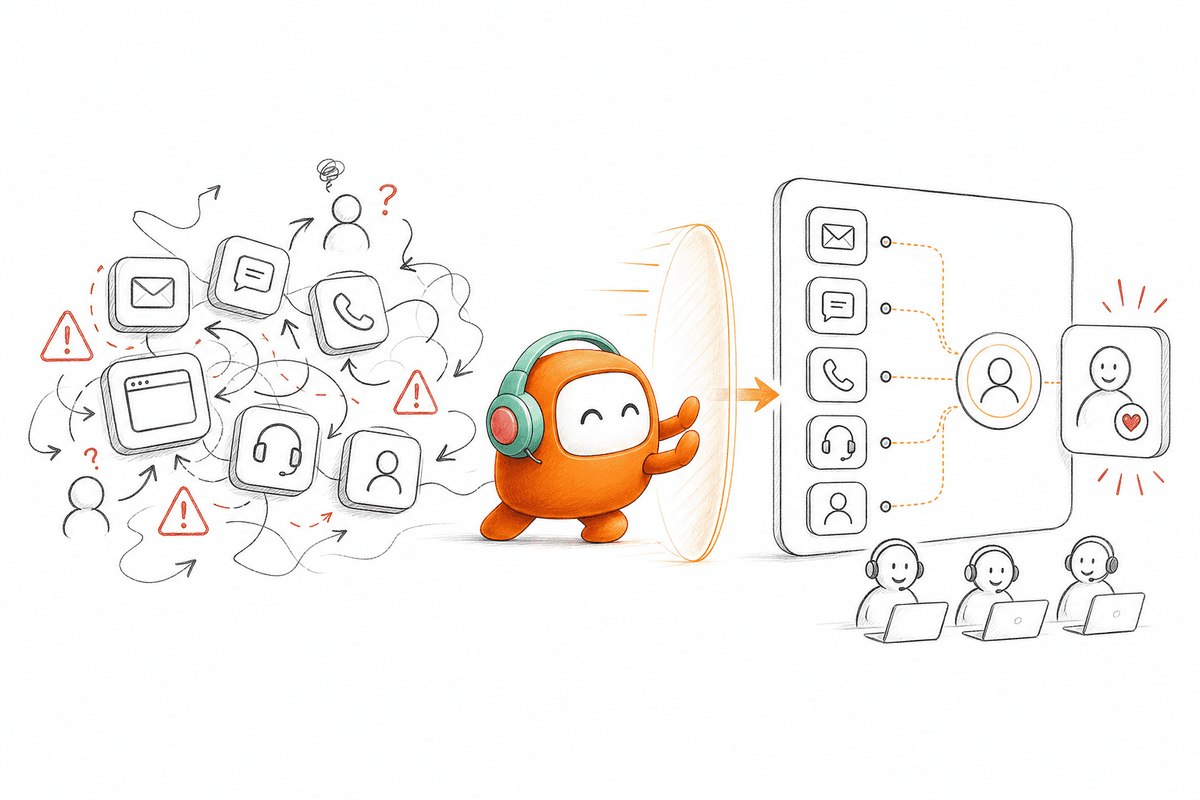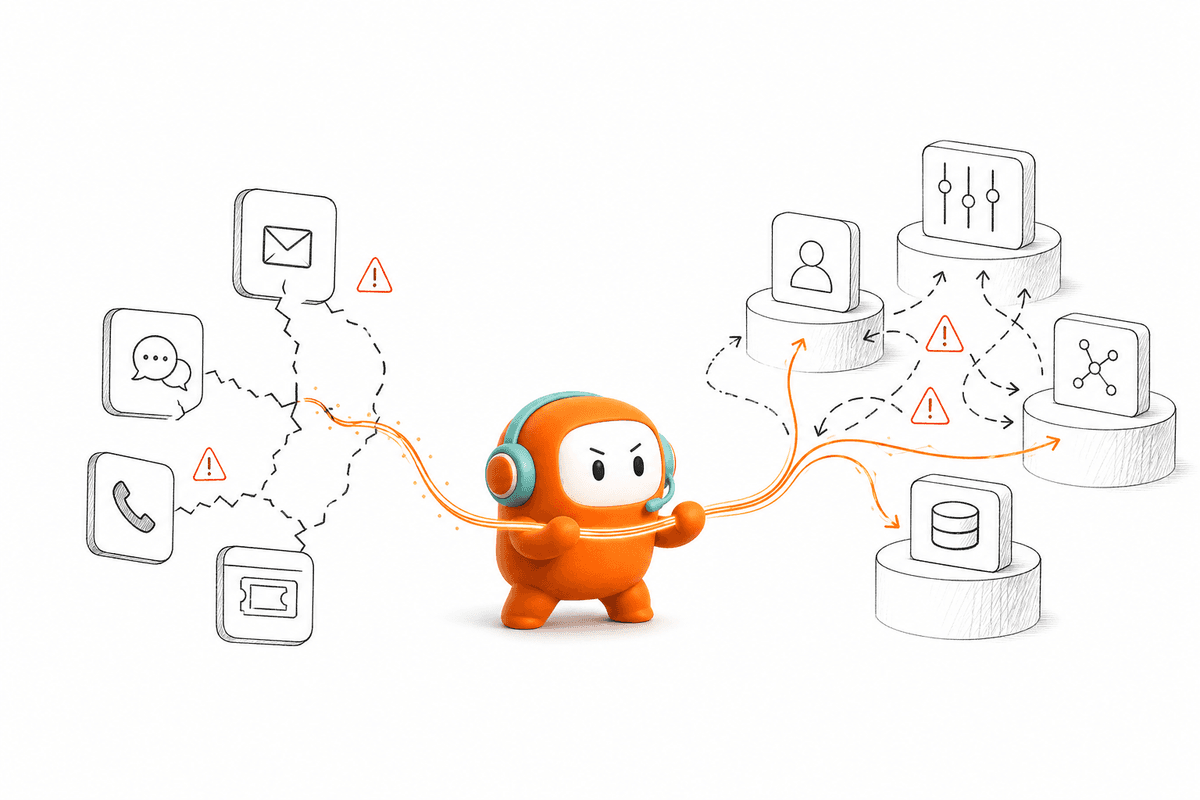
Your voice campaign blocks a customer after an opt-out, but the scheduled SMS still goes out. The consent record changed in one system and never reached the next channel. Multichannel outreach in regulated customer operations fails at that handoff, because automation can repeat the same policy mistake before a human sees it.
Most teams treat compliance as a final check placed beside the campaign. The hard part actually starts earlier, when the system decides who can be contacted, which channel is allowed, what policy applies, and what must happen after a reply. AI shouldn't become another queue. It should reduce queues by sharing context, knowledge, and workflow ownership with human agents.
Key Takeaways:
- Build outreach eligibility around the customer record, not individual channel lists.
- Apply consent changes and opt-outs before the next scheduled contact can run.
- Separate policy decisions from channel execution so every action has a clear reason.
- Route missing data and policy conflicts to a human instead of letting automation guess.
- Test blocked paths across channels, not only successful calls or messages.
- Keep legal ownership with your organization, even when software enforces configured rules.
Why More Outreach Channels Create More Compliance Gaps

One Update Can Break Between Two Systems
A collections manager pauses a call campaign after legal changes the permitted contact window. The dialer accepts the update, but the SMS platform still uses yesterday's schedule. An automated message goes out after the new cutoff because nobody updated the second workflow. The problem wasn't a careless employee; it was a system that required the same rule to be entered twice.
A multichannel outreach strategy for regulated workflows can't depend on people remembering every duplicate setting. Think of compliance as the routing table for customer contact. A routing table doesn't merely send traffic; it blocks paths that aren't allowed and records why. When every channel keeps a different table, the same customer can be blocked in voice and contacted through messaging five minutes later.
AI Can Become Another Compliance Queue
AI often gets added as a new execution layer while the old approval process stays untouched. The agent drafts or places the contact, then sends exceptions into a separate review queue with partial context. Human reviewers open the CRM, check the dialer, find the consent record, and reconstruct what the AI already knew. More automation has produced more coordination.
Frankly, a natural voice and accurate answer don't fix that operating model. If the agent can't check customer eligibility, respect configured restrictions, log the decision, and hand an exception to a person with its history attached, it isn't reducing compliance work. It is moving the work to another screen.
Fragmented Records Make Review Harder
Compliance review becomes expensive when one outreach decision must be reconstructed from several exports and conversation threads. A supervisor may need the customer record from the CRM, contact history from the dialer, an SMS delivery event, and notes from a human agent. If one timestamp or opt-out update is missing, the team can't explain the sequence with confidence.
Point tools still have a place. A low-volume team running one channel and one simple workflow may be better served by a narrow product, especially when a human can review every exception. Once outreach crosses several channels or business units, the coordination cost changes. Nobody wants to spend Friday afternoon proving why a message was sent on Tuesday.
The answer isn't another checklist beside every channel. It is one policy state that every channel must read before it acts.
How to Build Policy Enforcement Into Multichannel Outreach
Policy enforcement works when eligibility, consent, channel rules, execution, and handoff are treated as one workflow. Each contact attempt should begin with a policy decision and end with an auditable outcome. The channel is simply where the approved action happens, not where permission gets decided.
Find Where Policy State Splits
Start by tracing one customer across the full outreach sequence. Follow the record from enrollment through the first call, any follow-up message, an opt-out, and a possible human handoff. Write down which system makes each decision and which system only carries it out. Most hidden gaps become obvious when the journey is viewed as one timeline.
Your diagnostic threshold can be simple. If two or more answers below are "no," the multichannel outreach strategy for your operation is fragmented enough to pause expansion. Adding another channel before fixing those gaps increases the number of paths you must monitor. In my view, that is the wrong order.
Check the following:
- Can every channel read the same current consent status?
- Does an opt-out affect the next scheduled step before it runs?
- Can an agent see prior contacts without opening another system?
- Does every blocked attempt record the policy reason?
- Can operations test a rule change before publishing it?
Decide Eligibility Before Selecting a Channel
Channel availability isn't customer eligibility. A valid phone number proves that a call can connect, not that the call should happen. The same distinction applies to an email address, a WhatsApp account, or an SMS-capable number. Eligibility must be resolved before the workflow decides where to contact the customer.
Build one current eligibility record from the rules your legal and operations teams approve. The record should reflect consent, applicable contact windows, opt-out status, active restrictions, and the purpose of the outreach. Missing information shouldn't be treated as permission. If a required field can't be resolved, hold the contact for review rather than choosing the most convenient channel.
A practical sequence looks like this:
- Identify the customer and outreach purpose. Collections, lead follow-up, and service reminders may follow different configured policies.
- Check the current permission state. Read the latest approved record, not a copied campaign list.
- Apply timing and channel restrictions. Remove any route that isn't permitted under the configured rules.
- Select the next allowed action. Send, schedule, request approval, or stop the workflow with a reason.
Make Opt-Outs Change the Whole Customer Record
An opt-out is a customer-state change, not a channel event that can sit in an inbox. If someone withdraws permission during a call, the next SMS or WhatsApp step must evaluate that change before sending. A workflow that updates the voice campaign but leaves the messaging sequence active has recorded the request without enforcing it.
Some policies require channel-specific preferences, while others require a wider stop. That distinction matters, and the business must define it with legal review. Software should apply the configured rule consistently after the decision is made. If a channel can't read the updated state before its next action, pause the downstream sequence until synchronization is confirmed.
Before the opt-out, the campaign may contain three scheduled touches in three systems. After the opt-out, each pending step should be re-evaluated against the same record. No manual cleanup campaign. No assumption that another team will notice the note later.
Separate Policy Decisions From Message Execution
Policy logic should decide whether contact is allowed; channel tools should execute the approved action. Mixing both jobs inside each dialer, inbox, or messaging product creates duplicate rules that drift over time. It also makes audits harder because the decision and the delivery event live in different formats.
A strong event record answers four questions: who was evaluated, which rule version was used, what action was allowed or blocked, and what happened next. If operations can't answer those questions from one event chain, the campaign isn't ready to launch. The message content may be correct while the decision path remains impossible to defend.
Keep the workflow in this order:
- Evaluate the customer state against the active policy version.
- Return a clear decision such as allowed, blocked, delayed, or human review.
- Execute through the approved channel without reinterpreting the policy.
- Record the outcome and update the customer state before another step begins.
The separation requires more setup than placing rules inside a single dialer. That's a fair cost. It becomes worthwhile when the same customer can move among voice, SMS, email, and messaging without creating four versions of the truth.
Reserve Human Review for Real Exceptions
Human review belongs where judgment changes the outcome, not where systems failed to share data. A disputed identity, conflicting permission record, sensitive hardship disclosure, or unusual state requirement may need a person. Routine checks against approved rules shouldn't consume the same queue.
A channel-specific approval queue can work for a small program. The model breaks when reviewers must inspect several systems before deciding, because the queue becomes a manual integration layer. Give the reviewer the conversation history, policy result, customer state, and exact reason for escalation in one case. If any required context is missing, the system should hold the action rather than asking the reviewer to guess.
Use human review when:
- Customer identity can't be confirmed under the configured process.
- Two permission records conflict.
- The requested action falls outside approved workflow boundaries.
- A customer asks for an exception that automation can't grant.
- A regulated message requires approval before delivery.
Automation doesn't remove accountability. It removes repetitive checking so legal, compliance, and operations teams can focus on the cases where judgment actually matters.
Test the Blocked Paths Before Launch
Five successful test messages prove almost nothing about compliance enforcement. The useful tests are the ones designed to be blocked: an invalid contact window, a prior opt-out, missing consent, conflicting records, and an unsupported channel. Each blocked attempt should produce the expected outcome and a readable reason.
Cross-channel tests matter more than isolated channel tests. Start a call, record an opt-out, then verify that the pending message is stopped before execution. Change a policy version while a campaign is paused, then confirm every enrolled contact is checked again when the campaign resumes. A multichannel outreach strategy for regulated programs is only as strong as its least-tested transition.
Before launch, run these checks:
- Test at least five blocked conditions on every active channel.
- Test every opt-out path against all pending follow-up steps.
- Confirm human reviewers receive the full decision history.
- Publish a new rule version and verify older logic no longer runs.
- Roll back one test change and confirm the prior approved version returns.
A campaign should fail safely when data is missing or rules conflict. Successful delivery is not the only passing outcome; a justified block can be the more important one.
How Revve Runs Outreach in One Workspace
Revve brings policy checks, outbound execution, conversation history, and human review into the same customer operations platform. Voice, SMS, email, and supported messaging channels can work from a shared customer thread instead of separate campaign records. The approach keeps AI and human agents connected to the same context before, during, and after contact.
Shared Records Keep Channel Decisions Together
Inside Revve, outbound sequences can include an AI call followed by SMS, WhatsApp, messaging, or email. Each step can use available customer data and prior conversation history, while the unified AI and human workspace keeps activity in the same operational record. If a conversation needs a person, the human agent receives the thread, summary, and suggested next actions without reconstructing the case elsewhere.
The Omnichannel Inbox preserves channel history while maintaining channel-specific formats and delivery states. Compliance controls can evaluate configured consent status, contact windows, do-not-call restrictions, and opt-out requirements before outreach proceeds. AI-drafted messages can also enter an approval workflow when human review is required.
Mapping those shared records and handoff rules against one live campaign is more useful than watching a generic product tour, so book a demo around an outreach workflow your team already runs.
Configured Controls Still Need Customer Ownership
Revve can enforce configured TCPA, FDCPA, and state-level controls, but it doesn't define your legal position. Your legal and compliance teams still own consent standards, disclosures, policy interpretation, and approval. The platform applies those approved rules, records the evaluation, and routes exceptions into the same workspace used by human agents.
Operations teams can adjust scripts, workflows, routing, contact logic, and approval paths through no-code configuration, then preview and test changes before publication. Revve supports both cloud and on-prem deployment models, which can matter for teams with stricter data, security, or infrastructure requirements.
The operational point is straightforward: policy control, workflow execution, human review, and deployment choice can sit inside the same customer operations layer. For teams running outreach across multiple channels, that matters more than stitching together separate tools for campaigns, approvals, and handoffs.
Make Every Channel Follow the Same Rules
A multichannel outreach strategy for regulated customer operations succeeds when every channel reads the same customer state and follows the same approved policy. Calls, messages, approvals, opt-outs, and human handoffs must form one continuous record. Otherwise, each new channel adds another place for a valid rule to get lost.
Start with one real customer journey and trace every decision. Fix the split records before adding more automation. Better outreach doesn't come from contacting people in more places; it comes from making every contact explainable, permitted, and connected to what happened before.
FAQ
How do I ensure compliance in multichannel outreach?
To ensure compliance in your multichannel outreach, start by building outreach eligibility around the customer record instead of individual channel lists. Make sure that any consent changes or opt-outs are applied before the next scheduled contact can run. This way, you prevent sending messages to customers who have opted out. Additionally, separate policy decisions from channel execution so that every action has a clear reason. This structured approach helps maintain compliance across all channels.
What if a customer opts out during a call?
If a customer opts out during a call, it's crucial to ensure that this change is reflected across all channels before any further outreach occurs. Revve can help by applying the opt-out status to all pending messages, such as SMS or WhatsApp, to prevent them from being sent. This means that your workflow should be designed to evaluate the customer's consent status immediately after an opt-out is recorded, ensuring that no further contact is made without permission.
How do I test blocked paths in my outreach strategy?
Testing blocked paths is vital for a successful outreach strategy. Start by creating scenarios that intentionally trigger blocked conditions, such as invalid contact windows or prior opt-outs. Run these tests across all active channels to verify that the expected outcomes occur, such as stopping a message from being sent. Additionally, ensure that each blocked attempt produces a clear reason for the block, which helps in auditing and refining your outreach processes.
When should I involve a human reviewer in the outreach process?
You should involve a human reviewer in the outreach process when there are exceptions that require judgment. This includes situations where customer identity cannot be confirmed, there are conflicting permission records, or if a customer requests an exception that automation cannot grant. By reserving human review for these specific cases, you can streamline the process and ensure that routine checks do not overwhelm your team's resources.