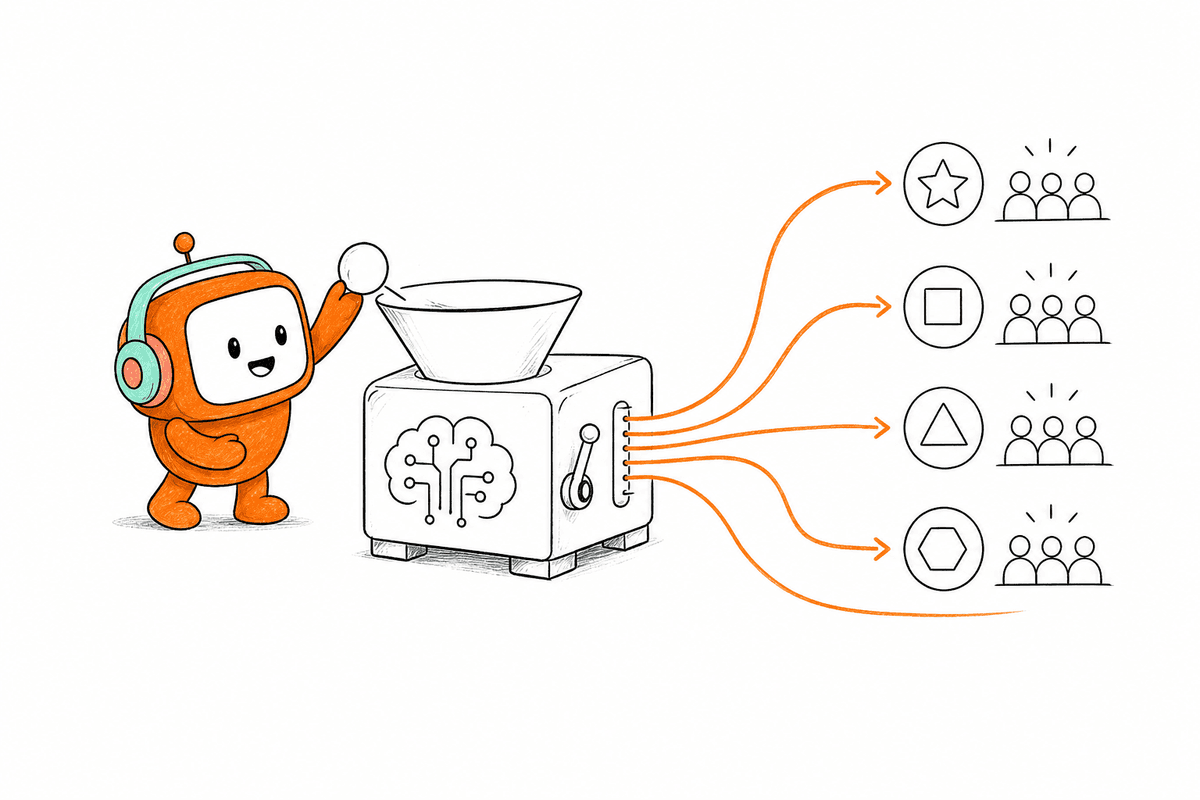
Sales teams don't improve lead conversion by making reps type faster. They improve it by removing the gaps between first contact, qualification, routing, and follow-up. A lead can get an instant reply and still sit untouched because the next action belongs to another system.
A fast reply has little value if it ends in a dead queue. The real measure is how quickly a qualified lead reaches the right rep with enough context to continue the conversation. Anything less is activity dressed up as progress.
Key Takeaways:
- Measure time to a completed sales handoff, not time to an automated greeting.
- Define qualification rules before leads enter a chatbot, form, phone flow, or messaging channel.
- Keep conversation history attached when a lead moves between channels.
- Route leads according to their next required action, not territory alone.
- Give automation the repeatable work and preserve human judgment for exceptions.
- Track qualification completion, owner acceptance, and follow-up outcomes in one workflow.
Why Faster Sales Follow-Up Still Fails

Every Point Tool Creates Another Handoff
A lead workflow often crosses more software than anyone admits. The form sends data to the CRM, a chat tool asks basic questions, a routing rule assigns an owner, and a separate dialer handles outreach. Each product may work correctly on its own while the complete sales process still breaks.
Separate tools aren't an irrational choice. A specialized dialer can handle calls well, and a mature CRM should remain the source of truth for accounts and opportunities. The problem begins when each system owns one step but no system owns the lead from first response through sales acceptance.
A polished form with broken routing is like a front door that opens into a locked hallway. The visitor got in, but nobody can reach them.
Instant Replies Can Hide Slow Sales Workflows
A demand generation manager opens HubSpot after lunch and finds a lead who submitted a form that morning. The chatbot already sent a greeting and collected a company name, so the response dashboard looks healthy. Yet the lead is still unassigned because the routing rule needed a field the chatbot never asked for. A rep finally calls without seeing the earlier conversation.
Foundational Harvard Business Review research on online sales leads found that companies contacting prospects within an hour were nearly seven times more likely to qualify them than companies waiting even one hour longer. Speed matters. Still, the lesson isn't simply to send a faster message. Sales teams improve when response speed connects directly to qualification and ownership.
The hidden cost lands on the rep. They repeat questions, chase missing details, and spend the opening minute proving that the company doesn't remember its own conversation. Customers notice that gap immediately.
Answer-Only AI Doesn't Complete the Work
AI that answers a question but can't route, log, follow up, or escalate creates another queue to manage. It may sound natural and return a relevant response, but the workflow stops at the exact moment sales action should begin. Someone still has to copy the details, choose an owner, and trigger the next contact.
Regulated teams face a harder version of the same problem. Qualification may need approved questions, consent checks, contact-hour rules, and human review for sensitive cases. A louder AI claim doesn't address any of those requirements. Precise boundaries and clear ownership do.
The root cause isn't a lack of automation. It's the absence of one operating layer that carries the lead from conversation to action, which raises the practical question: what should that workflow include?
How Sales Teams Improve Lead Qualification Before Routing
Sales teams improve lead qualification by treating it as one connected workflow rather than a chatbot task followed by CRM cleanup. The workflow must capture required facts, make a defined routing decision, preserve channel history, and trigger the correct next action. Faster replies matter only when each step moves the lead closer to a sales conversation.
Find Where Lead Response Loses Momentum
A fast first response can hide four slow steps behind it. To find the actual delay, follow one lead from arrival to rep acceptance and record every system, owner, wait state, and manual copy. Don't start with average response time because averages blur the handoff that failed.
The practical test is simple: can one person open a single record and explain what the lead said, how they were qualified, why they were routed, and what happens next? If the answer requires three tabs and a Slack message, the sales process is fragmented. Honestly, that test catches more problems than another dashboard.
Check the workflow in order:
- Arrival: Is the first channel and timestamp recorded?
- Response: Did the lead receive a meaningful question or only an acknowledgment?
- Qualification: Were all required facts collected using approved rules?
- Routing: Did the system assign a clear owner and next action?
- Acceptance: Can the team confirm that a rep received the lead with context?
If two or more answers are no, don't start by rewriting the chatbot prompt. Fix the ownership and data flow first. Better wording can't repair a missing handoff.
Define Qualification Before the First Conversation
Qualification should be decided before automation speaks to a lead. Otherwise, each channel collects different information, reps apply personal judgment too early, and routing rules depend on fields nobody reliably captures. A form may ask about company size while phone qualification asks about urgency, leaving the CRM with two incomplete views.
Start with the minimum facts required to choose the next action. For one sales team, that could mean use case, location, budget range, and purchase timing. Another team may care more about account type or an existing contract. The criteria can differ, but the decision behind each question must be explicit.
Document four parts before launch:
- Required facts: Information every qualified lead must provide.
- Branch conditions: Answers that trigger different follow-up questions.
- Exit outcomes: Qualified, incomplete, disqualified, or human review.
- Ownership rules: The queue or rep responsible for each outcome.
A scoring model alone isn't enough. If a high score doesn't produce a named owner and deadline, it is only a number in the CRM. Sales teams improve qualification when each outcome has an action attached.
Route According to the Next Required Action
What should happen after qualification? The answer should depend on what the lead needs next, not just region or company size. Territory can select the responsible team, but readiness should determine the route inside that team.
A buyer who requests an urgent conversation shouldn't enter the same queue as someone who completed only half the questions. Likewise, an existing customer asking about another product may need account-owner review before assignment. Routing gets sharper when the rule describes the next action instead of merely naming a destination.
Use conditional routes that sales can audit:
- If the lead qualifies and requests a meeting, assign an owner and trigger booking or live transfer.
- If the lead qualifies without booking, create an immediate follow-up action with the captured context.
- If required information is missing, continue the same conversation rather than restarting qualification.
- If the case needs judgment, route it to a human review queue with the reason included.
CRMs already provide structures for leads, owners, and opportunity conversion, as shown in Salesforce's Trailhead module on leads and opportunities. The missing layer is often the live conversation and workflow that produces clean input for those records. Keep the CRM, but don't make reps rebuild every lead inside it.
Preserve Context When the Channel Changes
A lead misses a phone call, replies by SMS, and later opens web chat. Three channels shouldn't create three separate sales conversations. The team needs one thread showing the questions asked, the answers received, and the action already promised.
Without that history, automation becomes repetitive. The SMS flow asks for company size after the voice flow already captured it, then the sales rep asks again because neither answer reached the workspace. From the buyer's side, the company looks disorganized. From the rep's side, valuable call time gets spent on retrieval rather than selling.
Keep these details attached across channels:
- Original lead source and arrival time
- Questions already asked and answers received
- Qualification status and reason
- Prior outreach attempts and responses
- Assigned owner and required next action
Channel continuity doesn't mean every interaction should look identical. WhatsApp, phone, email, and web chat have different formats and customer expectations. The operating record should remain consistent even when the conversation format changes.
Give Automation Repetition and Humans Judgment
Automation should handle repeatable qualification steps, while people own ambiguity, negotiation, and sensitive exceptions. That division is more useful than asking whether AI should replace sales development work. The better question is which decisions can follow stable rules without harming the buyer experience.
There's a valid case for keeping qualification entirely human when volume is low or every prospect needs deep technical discovery. Automation adds setup, review, and maintenance work. Once inbound volume starts causing delayed replies or inconsistent questions, keeping every first conversation manual becomes the more expensive choice.
Set human handoff conditions before launch:
- Escalate when the lead requests a person.
- Escalate when an answer falls outside defined branches.
- Escalate when the conversation shows confusion or negative sentiment.
- Escalate when policy requires review before the next message.
- Pass the full thread and qualification summary to the rep.
A handoff without context isn't a handoff. It is a restart, and customers shouldn't pay for your internal tool boundaries by repeating themselves.
Measure Completed Lead Workflows
Reply rate measures activity, while completed qualification measures movement. A team can report a near-instant first response and still lose leads between the bot, routing queue, and rep inbox. Measuring the complete path exposes where sales work actually slows down.
Track timestamps at each state change rather than relying on one broad response metric. You need to know when the lead arrived, when meaningful qualification began, when required facts were captured, when ownership changed, and when the rep accepted the lead. Frankly, anything less leaves too much room for a green dashboard beside a broken process.
The useful operating metrics are:
- Time to first meaningful response
- Qualification completion rate
- Time from qualification to owner assignment
- Time from assignment to rep acceptance
- Percentage of handoffs containing full context
- Follow-up completion by qualification outcome
Review failed paths as closely as successful ones. If incomplete leads repeatedly disappear after the second question, change the branch or channel. If qualified leads wait in an assigned queue, the automation isn't the bottleneck anymore. The remaining question is whether your current stack can run the complete workflow without adding another set of handoffs.
How Revve Runs One Qualification Workflow
Revve connects lead response, qualification, routing, and follow-up inside one customer operations platform. AI and human agents work from the same conversation record across supported channels, while qualification criteria remain controlled by the business. The existing CRM can stay as the account and opportunity record.
Qualification and Routing Share One Record
Revve's Lead Qualification workflow can respond to inbound leads across supported forms, phone, live chat, SMS, and WhatsApp. It asks questions defined by your team, evaluates answers against your criteria, and routes qualified opportunities to the correct sales action. The AI doesn't invent the qualification strategy because your business still defines the rules.
Conversation history stays inside the Unified AI and Human Workspace when a person takes over. The rep receives the thread, captured answers, and prior context instead of starting discovery again. Integrations, APIs, webhooks, and data sync can connect that work to the CRM rather than asking sellers to copy it by hand.
For a US geospatial and property data company, the operating problem involved outbound lead engagement and website lead capture tied to its sales process. Automating the isolated call wouldn't have solved the full requirement. The value came from connecting lead capture, engagement, and sales action as one workflow.
If your current lead flow crosses a chatbot, CRM queue, dialer, and agent inbox, book a demo to map that exact handoff inside one operating workspace.
Operations Can Change Rules Without Rebuilding
Revve gives operations teams no-code configuration, testing, and rollback controls for qualification logic, routing, tone, and scenarios. Teams can preview changes and test edge cases before publishing them. Initial integrations still need technical work, but daily rule changes don't need to become engineering tickets.
Outbound Orchestration handles the follow-up path after initial qualification, using configured sequences across supported channels. Timing, exit conditions, and messaging rules remain under business control. Revve can also apply configured consent, contact-window, do-not-call, and opt-out checks, while the customer remains responsible for legal review and policy decisions.
Cloud and on-prem deployment options give teams flexibility when data, security, or infrastructure requirements shape the rollout path. Precise deployment language matters more than a generic AI promise.
Revve isn't the right fit for every sales team. A business under 20 seats with low lead volume may find a simple point tool cheaper and faster. The platform makes sense when lead handling spans multiple channels, human and AI work, inbound plus outbound, and enough volume to justify one operating layer.
Better Lead Handling Starts With One Operating Layer
Sales teams improve lead conversion when the entire path from first response to rep acceptance has one owner and one record. Qualification rules must produce an action, channel changes must preserve context, and automation must know when to bring in a person. Faster messages alone won't fix a fragmented sales process.
Start by tracing one lead through your current stack. Count the systems, wait states, repeated questions, and manual transfers between arrival and sales acceptance. Improve that handoff, and the rep finally gets to sell.
FAQ
How do I handle edge cases effectively?
To manage edge cases effectively, start by defining clear criteria that trigger human intervention. For instance, if a lead expresses confusion or dissatisfaction, escalate the conversation to a human agent. You can use Revve’s Smart Escalation feature to automate this process, ensuring that the right context is passed along to the human agent. Additionally, regularly review these edge cases to refine your criteria and improve the overall workflow.
What if my team struggles with lead qualification consistency?
If your team faces challenges with lead qualification, consider standardizing your qualification criteria. Use Revve’s Lead Qualification workflow to define the necessary questions and scoring system. This ensures that all leads are evaluated uniformly, which can help reduce discrepancies in how different team members qualify leads. Regular training sessions can also reinforce these standards and improve overall consistency.
Can I track lead response times across channels?
Yes, you can track lead response times effectively using Revve. By utilizing the Omnichannel Inbox, all interactions are centralized, allowing you to monitor timestamps for each stage of the lead's journey. This feature helps you identify where delays occur, whether in initial responses or during qualification and routing. Regularly analyzing this data can help you optimize your processes and improve response times.
When should I escalate a conversation to a human agent?
You should escalate a conversation to a human agent when the AI encounters complex queries, negative sentiment, or when a customer explicitly requests to speak with a person. Revve’s Smart Escalation feature can help automate this process, ensuring that the full context of the conversation is passed to the human agent. This way, the customer experience remains seamless, and the agent can pick up right where the AI left off.
Why does my team need to preserve conversation history?
Preserving conversation history is crucial because it ensures continuity in customer interactions. When leads move between channels, having a complete history allows agents to understand previous interactions without making customers repeat themselves. Revve’s Omnichannel Conversation Management feature maintains this continuity, enabling both AI and human agents to access the full context of each conversation, which enhances customer satisfaction and reduces frustration.