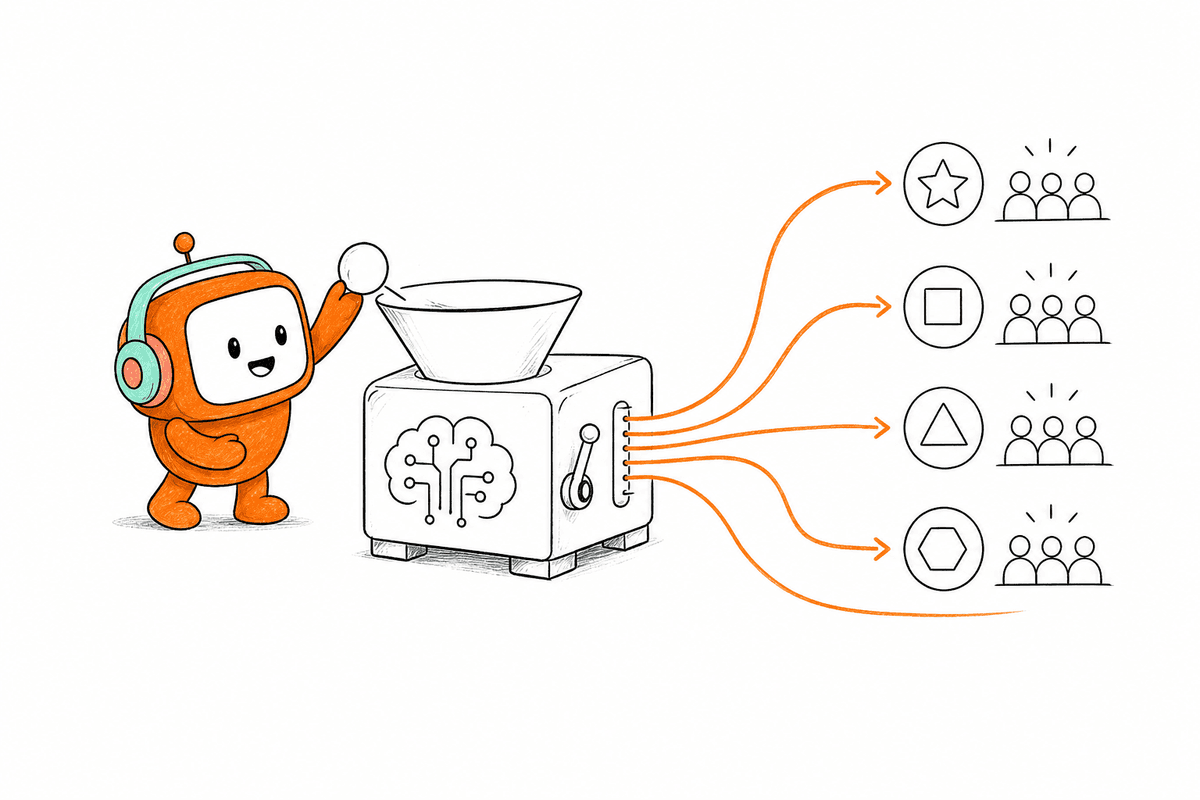
Most teams think outbound compliance is handled before launch. It is not. Legal can approve the script, ops can check the list, and sales can still create risk the moment a customer changes channel, replies after hours, opts out by SMS, or asks for a human.
The real compliance problem is not the message. It is the workflow around the message. Revve keeps consent, timing, approved scripts, opt-outs, handoffs, and evidence in one operating layer, so TCPA-aware outreach runs in the background instead of depending on every person remembering every rule.
Key Takeaways:
- A compliant multichannel outreach strategy should treat consent, contact windows, opt-outs, and escalation as live rules, not static review notes.
- Channel sprawl creates compliance risk because each tool holds a different part of the customer record.
- TCPA, FDCPA, and state-level outreach rules are workflow problems as much as legal problems.
- The safest outreach programs gate contact before launch, monitor conversations during contact, and preserve evidence after contact.
- Cloud-only AI vendors will lose regulated enterprises when on-prem deployment is a hard requirement.
Fragmented Outreach Creates Compliance Gaps
Fragmented outreach creates compliance gaps because every channel carries a different risk and most teams manage those risks in different tools. Voice has consent and time-window concerns. SMS has opt-out handling. Email has cadence and recordkeeping issues. Chat creates handoff risk when AI reaches the edge of its approved knowledge.
The Real Risk Lives Between Channels
The problem is rarely one bad message. It is the gap between systems. A customer opts out by text, but the dialer still has tomorrow's call queued. A collections agent updates a payment promise in the CRM, but the WhatsApp follow-up sequence keeps running. A support bot escalates a frustrated customer, but the human agent does not see the prior disclosure or consent state.
That is how a multichannel outreach strategy for compliance enforcement breaks. Not dramatically. Operationally. The call tool knows the call history. The SMS tool knows the opt-out. The CRM knows the account status. Nobody has the full truth in the moment when the next contact is about to happen.
Volume Turns Small Errors Into Policy Problems
At 200 contacts a day, a supervisor can spot-check enough interactions to feel safe. At 20,000 contacts a month, manual review becomes theater. It catches the obvious mistakes after they already happened, while the hidden mistakes keep moving through the workflow.
We have seen this pattern in customer operations teams that are genuinely trying to do the right thing. They build approval checklists, train agents, and document rules. Fair. Those controls matter. But once outreach runs across five tools, the checklist becomes a memory test for every agent and every campaign manager. The better question is simple: which rules are enforced by the system before the customer is contacted?
Compliance Is a Workflow Problem

Legal Approval Is Not Runtime Control
Legal approval is useful before launch, but it does not govern what happens during the conversation. The customer can interrupt. They can dispute the balance. They can say they are represented by counsel. They can ask the AI a question outside the approved script. If your workflow treats the approved script as the control, you are assuming the customer will follow the script too.
That assumption is wrong. Compliance teams know it, even if the software stack does not. The FCC’s TCPA guidance makes consent and unwanted calls a live operating concern, not just a documentation issue. For debt collection, the CFPB’s Regulation F resources show how communication practices, disclosures, frequency, and consumer preferences all become part of execution.
The Better Test Is Pre-Contact Enforcement
Before any campaign launches, ask five questions. Can the system check consent before the call or message? Can it block contact outside approved local time windows? Can it suppress records after opt-out across every channel? Can it require approval for sensitive AI-drafted messages? Can it preserve a full log if legal asks what happened?
If the answer is no to two or more, the compliance program is still mostly manual. That is not a moral failure. Manual controls make sense when a team is small, the channel mix is simple, and volume is low. Under 5,000 contacts per month, a human-led process may be cheaper and easier to govern. Once volume grows, the cost shifts from headcount to risk.
Multichannel Outreach Strategy for Regulated Teams
A multichannel outreach strategy for regulated teams needs one customer thread, one rule engine, and one escalation path. The goal is not to contact people on every channel. The goal is to contact the right person, on the right approved channel, with the right evidence behind every step.
Start With the Customer Record, Not the Campaign
A campaign-first team asks, "Who should we call today?" A compliance-first team asks, "What are we allowed to do with this customer right now?" That small change matters more than most workflow diagrams. It forces the team to start with consent, account status, channel preference, prior contact, state rules, and open disputes before selecting the next touch.
The practical rule is simple. If the customer record does not include consent status, channel preference, latest opt-out state, and last contact timestamp, do not enroll the customer in an automated outreach sequence. That sounds strict. It is. But it prevents the most common failure pattern: teams pushing a list into a dialer or messaging tool before the system knows whether contact is allowed.
Map Each Channel to a Specific Job
Voice, SMS, email, and chat should not all do the same work. Voice is better for high-intent conversations, urgent clarification, and cases where tone matters. SMS is better for short reminders, confirmation, and quick self-service links. Email works for longer explanations and formal records. Chat is useful when the customer is already inside a digital session.
A clean multichannel outreach strategy for compliance enforcement assigns each channel a job before the first message is written. For example:
- Voice: Use for verified conversations that may need explanation or escalation.
- SMS: Use for short reminders and approved follow-up.
- Email: Use for longer notices and documentation-friendly updates.
- Chat: Use for in-session support and authenticated customer questions.
The channel map should also include stop rules. If the customer opts out on SMS, suppress SMS. If the customer asks for a human on voice, route the conversation. If the customer disputes a collections claim, pause the automated sequence and require review.
The Operating Model That Keeps Outreach Governed
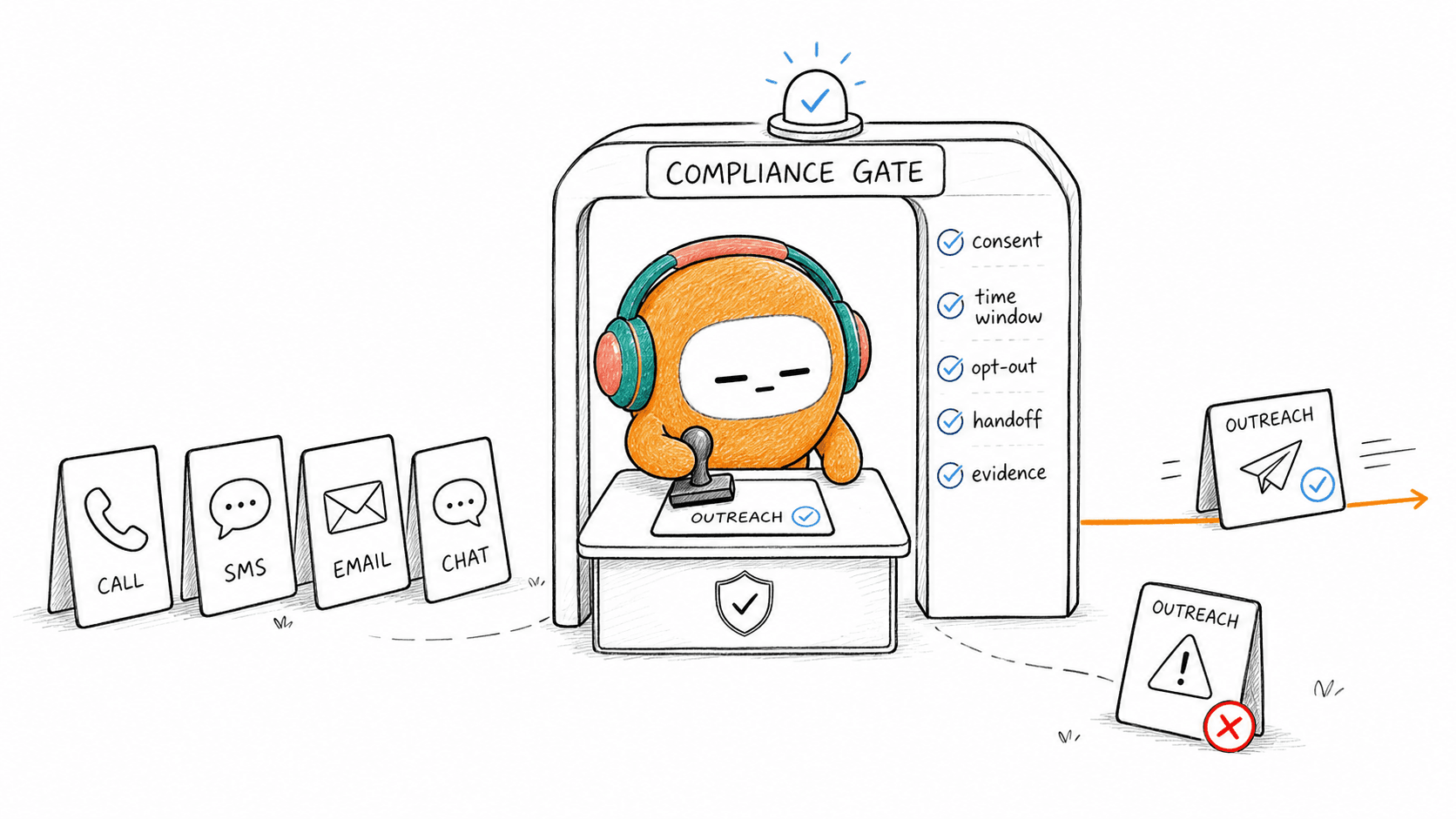
Governed outreach runs on three layers: pre-contact checks, live conversation controls, and post-contact evidence. Miss one layer and the program becomes brittle. Get all three working together and compliance stops being a bottleneck. It becomes part of the operating system.
Gate Every Contact Before It Happens
The gate is the moment before the system places a call, sends a message, or starts the next campaign step. That is where consent, time zone, DNC status, opt-out rules, account status, and customer preference should be checked. If the gate fails, the contact should not happen.
The useful threshold is hard. Any outreach workflow that touches regulated customers should block contact automatically when one required field is missing. No consent value? No outbound call. Unknown local time? No SMS. Active dispute flag? No collection follow-up until review. I prefer strict gates because exceptions are where risk hides. The business can always approve a controlled exception. It is much harder to unwind a thousand contacts that should not have gone out.
Control the Conversation While It Is Happening
Pre-contact checks are not enough because the customer can change the risk profile mid-conversation. They can revoke consent. They can ask for a supervisor. They can use language that requires a different disclosure or escalation. AI and human agents need live rules that decide when to continue, when to pause, and when to hand off.
A useful diagnostic is the "one-turn test." Take any active outreach conversation and ask: after the customer's next reply, can the system decide whether the next response is allowed? If the answer depends on an agent remembering a policy, the control is weak. If the system can check the rule, suggest the next action, and require approval when the content is sensitive, the control is stronger.
If you want to see how a governed contact window and opt-out check can be configured before launch, book a demo.
What Regulated Buyers Should Demand From AI Outreach Vendors
Regulated buyers should demand deployment flexibility, human handoff, rule enforcement, and evidence capture from AI outreach vendors. A polished demo voice is not enough. The vendor has to show how the system behaves when the customer says no, changes channel, disputes the message, or triggers a policy boundary.
Cloud-Only Is a Dealbreaker in Some Markets
Cloud-only AI vendors will lose the regulated enterprise to on-prem-capable platforms. That is not ideology. It is procurement reality. Banks, insurers, healthcare groups, and large financial services teams often have hard requirements around data residency, infrastructure control, security review, and internal governance. If the vendor cannot run where the buyer needs it to run, the conversation ends.
SEA BFSI is the clearest example. A Vietnamese bank running voice automation in production may need local-language handling, on-prem deployment, and a vendor that can work inside the buyer's infrastructure constraints.
Handoff Quality Is a Compliance Feature
A bad handoff is not just a customer experience issue. It can become a compliance issue because the human agent may not know what was already said, what disclosure was given, or why the AI escalated. The customer repeats the story. The agent guesses. The record becomes messy.
Ask vendors to show the handoff record, not the demo script. The record should include the full thread, prior channel history, customer profile, AI summary, reason for escalation, and suggested next step. If those pieces are not visible to the human agent, the automation is operating apart from the team. That is where customers feel the break and compliance teams lose confidence.
How Revve Enforces Governed Outreach
Revve enforces governed outreach by putting voice, chat, SMS, email, AI agents, and human agents in one customer operations runtime. Revve is not just a chatbot, not just a dialer, and not just a helpdesk. The platform is built for teams that need outreach to run with rules, context, and human review.
One Runtime for Voice, Chat, SMS, and Email
Revve brings conversations from supported channels into one operating layer, including voice, chat, SMS, WhatsApp, email, Messenger, Zalo, web chat, app chat, LINE, Instagram, and LinkedIn where configured. The point is not channel bragging. The point is continuity. A customer can move from a call to an SMS follow-up, and the internal team can still see the same customer thread.
Revve's Outbound Orchestration lets teams build multi-step campaigns across calls, SMS, WhatsApp, messaging apps, and email. Contacts can be enrolled through CRM sync or CSV import, and each touchpoint can carry prior conversation context instead of acting like a fresh blast. For compliance enforcement, the important part is that the outreach sequence, conversation history, and follow-up actions sit in the same system rather than being split across a dialer and a messaging tool.
Rules, Approval, and Human Handoff Stay Connected
Revve includes compliance controls and approval workflows for outreach. Before outbound contact or sensitive message delivery, the platform can check configured rules such as consent status, local time windows, DNC restrictions, and opt-out requirements. AI-generated messages can also go through approval workflows when the business wants human review before sending.
Revve's Smart Escalation and Full-Context Handoff keeps humans involved when the conversation needs judgment. Triggers can include negative sentiment, unresolved intent, keywords, duration, customer tier, or custom business rules. When escalation happens, the agent receives the thread, summary, prior context, and suggested next steps in the workspace. That matters because the goal is not to replace the team. The goal is to let AI handle the repetitive work while people own the conversations that actually need a human.
Next Steps
A multichannel outreach strategy for compliance enforcement fails when channels, rules, and customer context live in separate places. The fix is not another policy checklist. The fix is an operating model where every contact is gated before launch, controlled during the conversation, and recorded after the fact.
Regulated teams should be skeptical of any AI outreach vendor that only sells speed. Speed without governance creates more risk. The right system lets outreach move faster because the guardrails are built into the workflow, not because people are asked to remember every rule under pressure.